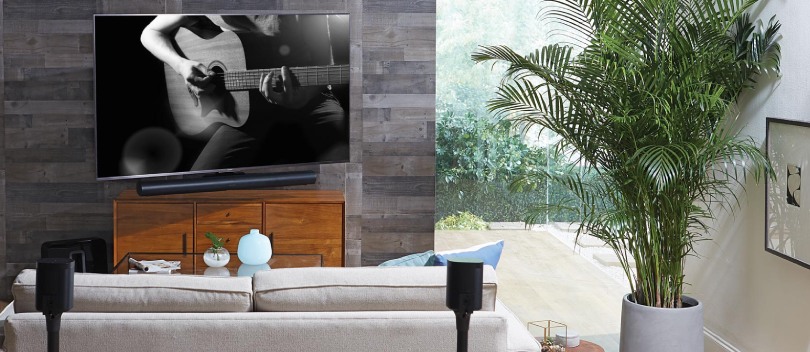
The ideal viewing distance for a television depends on more than screen size alone. Resolution, room layout and the height of your setup all affect how sharp, comfortable and immersive the picture feels. If you sit too close, fast scenes can feel tiring. If you sit too far away, you lose detail that your TV is capable of showing.
What is the ideal viewing distance for your TV?
A practical starting point is to match the viewing distance to both the diagonal size and the resolution of your TV. With Full HD, you usually need more distance than with 4K or 8K. In most living rooms, that means a 55 inch TV often feels right at roughly 2.1 to 3.0 metres, while a 65 inch TV often works well around 2.4 to 3.6 metres.
1. Start with screen size and resolution together
Many online charts only look at inches, but resolution matters just as much. A higher-resolution screen lets you sit closer without seeing pixel structure. That is why a modern 4K television can feel comfortable at a shorter distance than an older Full HD model of the same size.
2. Use these practical distance ranges
- 32 inch TV: about 1.2 to 2.0 metres.
- 43 inch TV: about 1.6 to 2.4 metres.
- 50 inch TV: about 1.9 to 2.8 metres.
- 55 inch TV: about 2.1 to 3.0 metres.
- 65 inch TV: about 2.4 to 3.6 metres.
- 75 inch TV: about 2.8 to 4.1 metres.
3. Think about comfort, not just immersion
The best TV viewing distance is the one that lets you enjoy films, sport and everyday television without straining your eyes or lifting your chin. If your seating position forces you to look up for long periods, it is worth reviewing both distance and height together.
4. Keep the centre of the screen near eye level
Distance works best when the TV is also placed at a natural height. If your screen sits too high, even the correct sofa distance can feel uncomfortable. That is why placement and support choice matter alongside screen size.
5. Match the setup to your room
In a narrow room, a huge screen is not always the smartest choice. If your sofa cannot move back far enough, a slightly smaller TV often creates a better overall experience. If you are still deciding on size, our guide on home setup choices can help you think more broadly about the room.
6. Use a stand when wall placement is limiting
If furniture, windows or cable routing limit where your TV can go, a floor solution can make positioning easier. The goal is simple: place the screen where both the height and the viewing distance work naturally with your sofa.
Common mistakes with TV viewing distance
- Choosing the largest screen without checking the room depth.
- Using the same distance rule for Full HD and 4K.
- Judging comfort without considering TV height.
- Sitting too far away and losing detail that should be visible.
Conclusion
The ideal TV viewing distance is a balance between inches, resolution and how your room is laid out. Start with a practical range for your screen size, then fine-tune based on comfort, picture sharpness and the height of your setup. That usually leads to a better result than chasing one fixed formula.